“I’m not afraid to die.”
It was almost winter. Between the span of unnervingly clustered brick walls and the foliage in its final phase of hue, I estimated that it would take one child approximately thirty maroon crayons to capture the view outside the hospital window. I pulled absently at the plastic ties that held a flimsy paper blue smock over my clothes.
On the door next to me, a neon-colored poster extolled the need for anyone who entered the room to wear protective barriers. DON’T SPREAD GERMS. In addition to the paper smock, I wore plastic gloves, a paper bonnet around my hair and a surgical mask. My brother, Dan, lay in the bed by the window. He was sick. And he was waiting.
Dan was telling me about the night he was taken to the hospital almost two months before we sat having this conversation. He said he laid on the carpet in his living room and closed his eyes.
“I wasn’t afraid,” he repeated. He told me that when he thought he was about to die, he just accepted it and didn’t try to fight it.
“The only reason I called an ambulance is because I couldn’t take the pain.” Dan wasn’t wearing his glasses, so I assumed the window’s view was just a blob of rusty smudges to him.
He didn’t want to live. He just didn’t want it to hurt so much to die.
I wasn’t sure what I was supposed to say. Four days a week for eight weeks, I had been traveling from New York’s Port Authority bus station to a hospital in Newark, New Jersey to view my brother in various stages of lucidity. Early in his hospital stay, he endured several mind-boggling surgeries including one that adjoined him to a pump the size of a riding lawnmower that worked on behalf of both sides of his heart to siphon blood through his body. Because of the trauma of this experience, he was kept in a constant state of forced sedation, only waking when they roused him out of the stupor.
As his heart grew slightly stronger, he would be awake for longer periods. During one particular waking moment early in his hospitalization, he told me he was seeing ghosts. Dan was on a ventilator at this time, so we communicated via shaky handwritten notes.
He pushed the notebook at me. His note read, “It’s like Hellboy.”
I said, “The movie?”
Nod.
“Never saw it.” I shrugged.
Shrug. Smile.
On the day that he was telling me he wasn’t afraid of dying, Dan was clear headed. He sat up in a chair. He could speak clearly because there weren’t tubes down his throat. We were listening to Stevie Ray Vaughan. He was eating fruit salad. A smaller, portable machine still pumped half his heart for him, but the machine was on wheels, so he could walk short distances with it, shuffling along in grippy socks that sagged around his ankles.
Every day that I visited, he would tell me how many laps he completed around the nurse’s station. Things seemed to be going well. For a few weeks, I was able to just hang out and talk with him without having to decipher his scribbled notes.
“There have to be things you still want to do in life,” I offered gently.
He shrugged.
I didn’t want to look him in the eye. I stared at the ugly tile floor, but I continued.
“Places you want to see? Things you want to do?”
My voice trailed off. I wasn’t sure if I even believed what I was saying.
***
Once, I found myself similarly disqualified to convince someone of the value of life. One of my best friend’s, Dennis, had spelunked into depths that none of us had thought previously reachable. He was being evicted from his apartment and fired from his job at the exact same time. His nose was about to fall off from all the powdered substances he had been vacuuming up and he was going to the free clinic to get tested for STDs so frequently they should have given him a punch card. His life was in disarray.
Dennis had actually requested that we, his best friends, intervene because his life was careening dangerously close to complete destruction. He sent us a dramatically succinct email that read, “This is it. I mean it. Intervene.”
The other friends he summoned from our group were Betsey and Patrick. We form the inner circle of a group of friends forged in the fires of the theatre arts program at a hyper intellectual liberal arts college we all attended in Kalamazoo, Michigan. Betsey, Patrick and I felt a bit strange about having an intervention because none of us were what you might describe as “sober” people. To illustrate how ill-equipped we were at hosting a meeting to tell someone they need to stop imbibing, you can just ask where we had this intervention.
We had it at a bar.
Not just some bar, but one of our most regular haunts. An Irish bar on the Upper West Side with a dart board, dark wood walls and bar stools sticky with last night’s revelry. The bartender recognized us and halfway through our emotional gathering, he sent over a round of shots.
“Okay, but Dennis. . .” I slurred, “After this shot, no more drinking.”
Betsey and Patrick nodded. We tapped the tiny glasses together and gulped in unison.
“Yes. What Marisol said. Last one for you, D.” Patrick motioned to the server and ordered another round of cocktails for us and a water for Dennis.
I found myself feeling like I should say the things people say and mean but don’t really know how to express outside of clichés. Things like, “You have so much to live for,” “Don’t throw your life away,” But I didn’t say any of that. I said very little. I sipped my vodka and waited for someone else to speak.
***
Sitting next to my brother’s bed in his hospital room, I felt the same mute impotence. I wasn’t sure if he wanted me to convince him how great life is and how much he should want to fight for his life. I realize now that he may have wanted me to tell him it was okay to just let go. Maybe there’s not that much to stick around for.
“I just don’t want you guys to be sad.” Dan tapped on the metal bars of his bed that stopped him from falling out or escaping.
There were two things we eventually agreed on that Dan could look forward to: watching our niece and nephews grow up and getting to fly his airplane again. My brother was a pilot, and he designed flight simulations for the military as well as video games.
I promised Dan that if he could find the strength to get himself well and get out of that fucking hospital, we would fly his little Cessna to a new place every week. I would personally show him how great life can be.
At the time, I was working two bartending jobs to pay for rent on an apartment I couldn’t afford to spend time in. I didn’t file taxes or use a bank account because both my jobs were off the books. My freezer had stacks of twenties piled in the ice cube tray, so I paid for everything with actual cold cash. I was sleeping with a guy whose name in my phone was just Drummer Guy F Train. My days and nights were spent either serving alcohol or consuming it and usually both.
Was I remotely qualified to prove the value of life to someone?
I never got the chance to find out.
The night my mom called me to tell me Dan passed away, it was very late. She woke me up. I was in my apartment in Hell’s Kitchen in Manhattan and Dan died in a hospital an hour away. I told my mom I would take a bus in the morning and be there first thing.
She said, “You sure you don’t want to see him one last time?” I wanted to tell her I had already seen him for the last time, and I didn’t need or want to see his dead body.
The last time I saw him he was alive. The nurses were huddled over Dan’s bed prepping him to perform some sort of task. I don’t know what. There were always so many machines attached to him and procedures done that I didn’t ask about. I saw just the top of his head and his eyes through a slit between the hanging curtains surrounding his bed. It was weird to see him without his glasses on. My last words to my brother were, “I’ll be back later, okay?”
***
Baybayin (sometimes also called Alibata) is an ancient Philippine script that faded from use when the Spaniards colonized. That’s putting it too mildly, of course. The invading Spanish forces actively influenced the indigenous people to use the Latin alphabet instead. They made the natives use their Spanish words instead of the ones they already had. It is one of the first things an occupying rulership does to dominate people—erase their language.
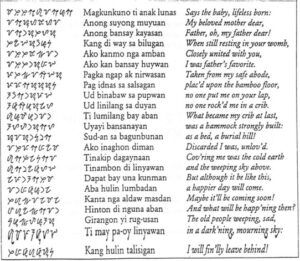
I was thirty and my brother was three months shy of turning thirty-four when he died. It was the first significant loss I had felt in the world, and I wanted to commemorate it with something that I knew would cause me to feel pain and create a permanent physical mark. So, I got a tattoo that covers most of my back with a poem written in Baybayin.
When I read the poem, it all sort of fell into place for me. A tattoo of a poem in an ancient script that got wiped out by violent settlers in my ethnic homeland. In blood red ink. Down my spine.
I got the red ink poem tattoo at a parlor in the city with loud rock music where they burn Nag Champa incense, and everyone has full sleeves of ink on both arms as well as several piercings. It took a few hours and any moments that I felt discomfort or pain I would breathe through it and focus on my brother and how I deserved to hurt a little.
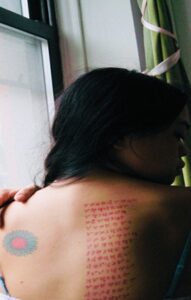
Two things happened after I got that tattoo. First, I learned that I had a mild allergic reaction to red ink. For months, maybe even a couple years after I got the tattoo done, the squiggly red lines on my back were raised and sometimes itchy, especially whenever I was in the sun. You could run your hand down my back, and I imagine it felt similar to reading braille.
That year, I also started partying and using cocaine pretty heavily and I lost a significant amount of weight. It was the early aughts and backless shirts were a big thing, so I got to show off my thinner body and my tattoo a lot. People, usually straight men, would comment on the tattoo and use it as an excuse to rub their sweaty palms up and down the length of my spine.
Whoa, is that like a brand or something? What is that–is that a tattoo? Why’s it raised like that? Is it henna? And, very racistly, What’s that, a menu?
Because of its visibility, the second thing that would happen a lot is people would ask me what it says. I had a standard reply line.
“It’s a poem in an ancient script from the Philippines that got wiped out by the Spanish colonizers.”
“Cool. What’s it say?”
“It’s, like, a letter from a dead baby to its parents.”
Usually, the conversation would end there. Awkwardly. You can’t say “dead baby” to someone without making things uncomfortable. Also, what did they expect? That I might just launch into a brief dramatic recital of a text that’s obviously kind of personal to me?
Often though, people would continue to challenge me. “But do you know the words?”
I hate that. Anyone with tattoos gets tired of discussing them at some point, but having a poem in another language presents a different challenge of explanation that feels needless to me. Of course I know the words, idiot. Why would I get something tattooed on me and not know what it says?
The truth is I don’t have it memorized. I have to find the screenshot or pdf every time I want to remind myself of the actual words. It doesn’t matter what it actually says, anyway. I know what it means.
***
I recently returned to the Philippines for only my third visit in my four decades of life. While I was there, I had a conversation with a taxi driver named Felipe who picked me up from the airport in Manila.
Felipe effortlessly negotiated the balletic chaos of traffic with motorbikes weaving recklessly between undefined lanes filled with colorful jeepneys and vans with tinted windows. I told him that I hadn’t been back there in almost sixteen years and that most of my mother’s side of the family lived in the States now.
“But my father is from Camiguin, and I still have some relatives from his side here.”
Felipe met my eyes in his rearview mirror and smiled. He told me it was good that I was reconnecting with my homeland and that he had just recently moved to Manila with his daughter and son.
He explained that his wife had died in an accident. During a typhoon, the bangka (boat) she was on capsized.
“There were thirty people on the bangka,” he explained.
I waited for him to complete his story about how all these passengers on the boat died in such a tragic and violent manner.
“Everyone else survived. Only my wife died.”
I must have gasped.
“Because. She could not swim.”
“I’m so sorry.” I looked out the window as the sky darkened over the Pasig River and the multicolored lights illuminated the curved bow of the Ayala Bridge.
Felipe shrugged and smiled at me. “Well, she was from Tarlac.” He rolled his r when he said it. Tarrrrrrlac.
He said this to me as though it was a reasonable explanation and that I should inherently understand the futility of expecting fairness in this life. When I looked at a map later, I saw that Tarlac City is in the center of Luzon island. It is so many miles away from the water.